
The global transition toward electric mobility has triggered a quiet but intense architectural battle beneath the sheet metal of modern electric vehicles (EVs): the standardization of charging infrastructure. Just as the early computing era grappled with competing hardware interfaces, the automotive sector currently navigates several regional and engineering protocols. Among the most prominent of these are the Chinese GB/T (Guobiao/Tuijian) standard and the European-led CCS2 (Combined Charging System 2) interface. Understanding the physical, electrical, and strategic differences between these two systems is critical for manufacturers, policymakers, and consumers moving through the global EV landscape.
1. Design Philosophy and Physical Architecture
The most immediate distinction between GB/T and CCS2 lies in their structural architecture and plug designs. They represent fundamentally divergent philosophies on how an electric vehicle should receive alternating current (AC) and direct current (DC).
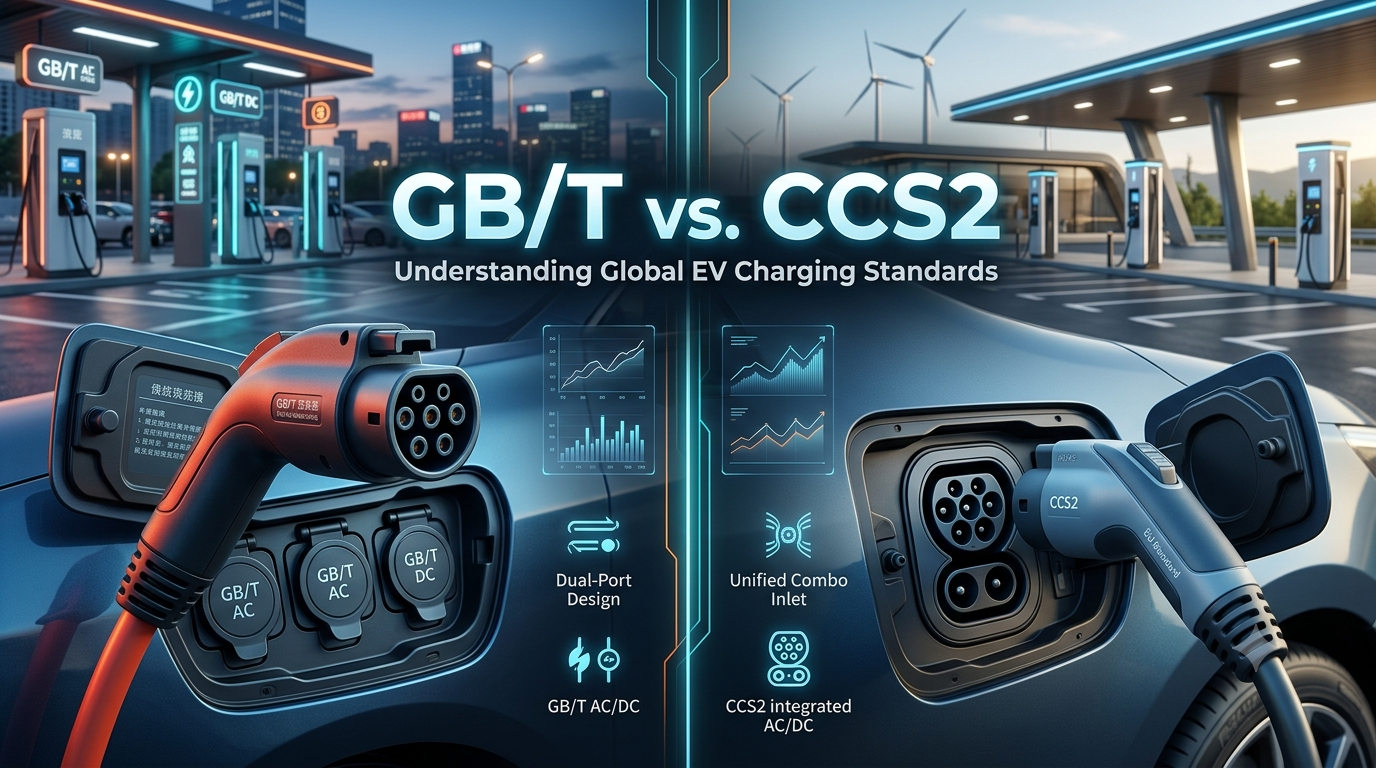
The CCS2 standard, widely mandated across Europe and adopted extensively throughout Oceania, South America, and parts of Asia, relies on an elegant, integrated design philosophy. It modifies the standard Type 2 AC plug by appending two massive, dedicated DC power pins directly beneath the existing structure. This creates a single unified vehicular inlet. When charging at home or via destination chargers, the top Type 2 portion accepts AC power. When plugging into high-power highway corridors, the massive CCS2 combo connector occupies the entire unified inlet, routing high-amperage DC directly to the battery packet. This dual-purpose design eliminates the aesthetic and engineering need for multiple physical ports on the vehicle body.
Conversely, China's GB/T standard employs a completely decentralized, dual-port strategy. Vehicles engineered under this paradigm feature two separate physical inlets, typically hidden behind distinct flaps on the vehicle: one dedicated exclusively to AC slow/medium charging and another entirely separate port configured for DC fast charging. The GB/T AC plug physically resembles a reversed Type 2 design, while the GB/T DC plug is a unique, seven-pin robust interface. This split-port architecture means a GB/T-compliant vehicle must allocate interior body space and distinct internal high-voltage routing for two discrete systems.
| Feature | GB/T Standard | CCS2 Standard |
| Primary Region |
China (and select export markets) |
Europe, Oceania, parts of Asia & S. America |
| Inlet Design |
Dual Ports (Separate AC and DC ports) |
Single Unified Port (Combo AC/DC inlet) |
| Max DC Voltage |
Typically up to 750V / 1000V |
Up to 1000V |
| Max DC Current |
Up to 250A (legacy) / 400A+ (newer variants) |
Up to 500A (liquid-cooled) |
| Communication Protocol |
CAN Bus (Controller Area Network) |
PLC (Power Line Communication) via HomePlug Green PHY |
2. Electrical Capabilities and Performance Limits
Beyond structural configuration, the electrical limits of these standards determine how rapidly a vehicle can replenish its energy cells. Both standards support high-voltage charging, but their operational parameters vary based on historical iterations and hardware designs.
CCS2 was built from the ground up to support extreme commercial and passenger vehicle high-power configurations. In its standard execution, it handles up to 1000 volts DC and can comfortably manage currents reaching up to 500 amperes when paired with liquid-cooled dispenser cables. This translates to an active power output capability of up to 350 kW to 500 kW under premium ultra-fast charging infrastructures, allowing compatible vehicles to charge from 10% to 80% in under twenty minutes.
The classic GB/T DC system, which forms the spine of the world’s largest unified charging network across China, traditionally operated at lower threshold ceilings—frequently capping out at 750V or 1000V with a standard maximum current of 250A or 400A. This typically restricted field deployment speeds to roughly 180 kW to 250 kW. To combat this limitation and prepare for a future of ultra-fast mega-watt charging, Chinese regulatory bodies teamed up with CHAdeMO to develop a next-generation backward-compatible system known colloquially as ChaoJi (or GB/T 2015+), designed to achieve power outputs exceeding 900 kW.
3. Control Communication Protocols
A critical, hidden layer of differentiation exists within the digital handshake that occurs the moment an EV plug is coupled to a vehicle. Charging is not a passive transfer of electricity; it is an active, microsecond-by-microsecond data negotiation involving safety checks, battery health state, thermal boundaries, and billing processing.
The GB/T standard relies explicitly on the CAN Bus (Controller Area Network) communication protocol. CAN Bus is an industry-veteran automotive networking standard used for decades to allow microcontrollers inside a vehicle to talk to one another without a host computer. It is incredibly robust, highly resistant to electrical noise, and computationally simple to implement. Because the charger and the car converse using native CAN topology, the integration process is straightforward and exceptionally reliable.
CCS2 approaches digital handshaking via a more complex, modern standard: PLC (Power Line Communication)utilizing the HomePlug Green PHY protocol, mapped to international standards ISO 15118 and DIN SPEC 70121. Instead of dedicated communication lines parsing simple telemetry, CCS2 overlays high-frequency digital data directly onto the pilot control pins. This network approach handles much larger data packets, paving the way for advanced features like "Plug & Charge"—where a driver simply inserts the cable, and the vehicle securely identifies itself, authorizes the session, and processes payment automatically without needing external RFID cards or mobile applications.
The Adapter Dilemma: Because GB/T and CCS2 speak entirely different physical and digital languages (CAN Bus vs. PLC), building adapters between them requires active, powered conversion circuitry inside the adapter block. This makes cross-compatibility adapters significantly more expensive and technically complex than simple pin-to-pin re-routing sleeves.
4. Global Geopolitics and Market Implications
The distribution of GB/T and CCS2 is deeply intertwined with regional trade policies and domestic supply chains. GB/T dominates China, a country that represents nearly half of the world's total passenger electric vehicles. Because of this massive domestic volume, Chinese manufacturers enjoy unparalleled economies of scale. When these brands export vehicles to regions dominated by CCS2 infrastructure, they face a critical fork: they must re-engineer the vehicle's bodywork and internal wiring harnesses to accommodate a CCS2 combo inlet, or rely on localized distribution networks deploying costly external aftermarket converters.
CCS2 has effectively become the international benchmark for open, multi-brand regional infrastructure across Europe, Southeast Asia, India, and Australia. Its unified design makes it highly attractive to municipal planners who wish to avoid deploying redundant hardware cables side-by-side at a single parking hub.
5. Conclusion
In summary, neither standard is objectively superior; rather, they reflect the unique domestic mandates of their originating markets. The CCS2 interface excels in space-saving physical integration and sophisticated software communication features like automated Plug & Charge, making it a highly streamlined choice for diverse international markets. The GB/T standard, conversely, benefits from unmatched volume deployment, structural ruggedness, and a dependable CAN Bus communication architecture. As electric vehicle adoption moves toward ubiquity, understanding these fundamental boundaries remains vital for navigating the global automotive supply chain.